
Case study · SECURITY · 2607.SEC.02
Nythera: autonomous penetration testing that proves every finding
How do autonomous penetration-testing tools avoid reporting false positives?
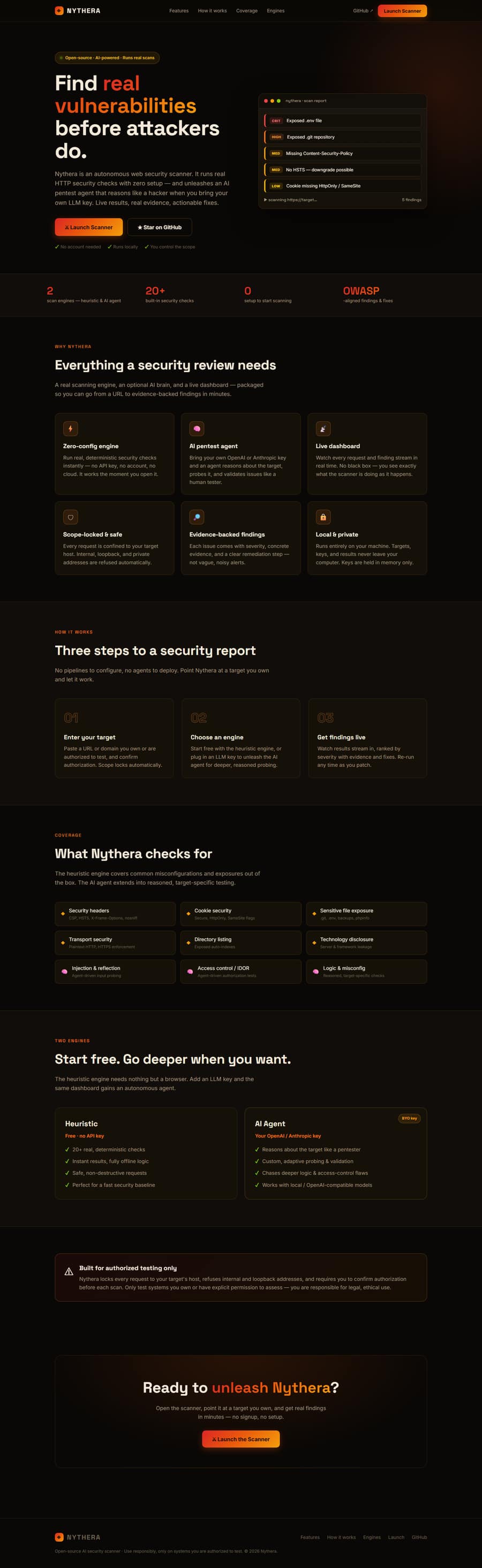
Nythera avoids false positives by refusing to report anything it can't prove: every active finding needs physical evidence — a database error signature, an unencoded reflected payload, real command output, a file signature, or evaluated template math — or it's discarded, not downgraded. It's an open-source, MIT-licensed scanner for in-house web applications, with internal-network scanning switched off by default.
- Vulnerability classes
- 9, all validated
- Workflow phases
- 7 (PTES-style)
- Internal-network mode
- Off by default
- CI gate
- Exit code 2 at/above --fail-on severity
- Stack
- Python · FastAPI · async HTTP · SSE · optional LLM agent · Docker
- License
- MIT
01The problem it solves
Automated scanners are noisy. A report with forty 'possible' findings teaches a team to ignore the report — and the one real vulnerability goes with it. At the same time, the most useful place to scan is the one most scanners can't reach: behind the login, on internal hosts.
02What he built
A seven-phase, PTES-style workflow
Reconnaissance (headers, cookies, TLS, tech disclosure) → attack-surface mapping (an in-scope crawler for endpoints, forms and parameters, plus content discovery) → API import (OpenAPI/Swagger and GraphQL introspection) → active exploitation → access-control testing (authenticated vs anonymous) → an optional LLM agent deep-dive → reporting with OWASP and CWE mapping.
Nine validated vulnerability classes
SQL injection (error signatures + boolean inference), reflected XSS, OS command injection, path traversal / LFI, server-side template injection, open redirect, broken access control, GraphQL introspection exposure, and security misconfiguration — each confirmed by its own evidence signature.
Built for in-house applications
Authenticated scanning (Bearer, cookie, custom headers, HTTP Basic), self-signed TLS, host-locked scope with include/exclude rules and a request rate limiter. A live FastAPI dashboard streams phases and findings over Server-Sent Events; a headless CLI exits with code 2 when a finding meets a severity threshold, so it can gate a CI/CD pipeline.
03 — THE HARDEST DECISIONMake the dangerous capability opt-in
Scanning localhost, private IP ranges and internal hosts is exactly what makes Nythera useful for in-house testing — and exactly what makes it dangerous if it's pointed somewhere it shouldn't be. So internal mode is off by default and has to be switched on explicitly; requests stay host-scoped; private hosts are refused unless internal mode is on; and every scan requires an authorization confirmation first.
The same principle governs the LLM agent: it's an optional phase that reasons about the target and probes further, never a replacement for the validated checks underneath it.
04The result
Reports a team can act on: deduplicated findings with severity, evidence, remediation and OWASP/CWE mapping, exportable as HTML or JSON — and a CI gate that fails a build only on proven issues.
RESEARCHResearch findings from this project
R-03A finding is not a finding until it is confirmed
Every active check needs physical evidence — a DB error signature, a reflected payload, real command output — or it's discarded, not downgraded.
R-04The dangerous capability is the one you default to off
Internal-network scanning is a separate, explicitly authorized switch, host-locked with include/exclude rules and a rate limiter in front.
NOTESQuestions this project answers
STACKTech stack
- Python
- Async HTTP
- LLM agent loop
- Docker